Thursday, May 22, 2014

The LinkedIn Code: An interview with author Melonie Dodaro

MELONIE DODARO is the founder of Top Dog Social Media, a social media agency that helps brands, businesses, professionals and sales teams use social media marketing and social selling to boost their visibility, attract new customers and increase their revenue. Dubbed by the media as Canada’s #1 LinkedIn expert and social media strategist, Melonie provides LinkedIn training to corporate sales teams and speaks worldwide at both industry and corporate events and conferences.

Yesterday, Melonie visited Ton De Graaf's 'Worldwide Coaching magazine' blog at http://worldwidecoachingmagazine.com, where he asked about LinkedIn Ads and how to create a 'virtual presence' in order to stand out from the crowd. Today, I'd like to share with you a recent interview I had with Melonie where I asked her about LinkedIn premium accounts, positive posting and activity levels in LinkedIn groups.

RICH: You put a lot of emphasis - rightfully - on branding yourself with a strong LinkedIn profile. But what if you are a "mutt"? For example, I am a freelance writer, a public speaker on communications skills, and a psychotherapist - and all three are important parts of my livelihood. Or, to use a bigger example, Bill Gates was both a software CEO and a philanthropist. What is your advice to people whose career descriptions use the word "and" a lot?

MELONIE: Like you, I also offer more than one set of services to a variety of different ideal clients. The first thing you need to do if you are in this position is determine if your ideal clients for each product or service use LinkedIn.
Once you have determined which products or services are the best fit for LinkedIn, you need to pick the best two or three of these. More than this will make it difficult to ensure that your profile is optimized well for search and it also becomes too much information for your ideal clients to read through when they land on your profile.
After you have your top two or three, then you need to make sure that you address each appropriately, in your Headline, Summary, Experience and Skills sections.
RICH: How active should you be in a LinkedIn group? Of course you shouldn't spam or post self-serving messages. But is there a point past which you are "too" present in an affinity group, even posting appropriate messages?
MELONIE: Often one post a week is sufficient for each group, with most of your time being dedicated to either replying to people who have commented on your posts or reading and commenting on others posts and comments. The engagement and interaction is often just as, if not more important than the act of posting itself.
As long as you are making positive and helpful comments that make sense, it is unlikely that you could be too active.
RICH: You do a good job laying out the features of LinkedIn Premium accounts. Should most small business owners get one?
MELONIE: Not at all. Most small business owners will only ever need to use the free version of LinkedIn.
Situations where you might consider upgrading would be:
  • If you are sending semi frequent InMails, which are costly if you are purchasing them individually
  • If you have a lot of people viewing your profile everyday and you want to use the Who’s viewed your profile page to see everyone who has viewed it or to better understand the general demographics of those viewing it.
  • If you would like to increase your ability to narrow your searches with the premium search fields as well as to increase the number of saved searches you are allowed and the number of results displayed from each search.
I hope you enjoyed this brief interview with award-winning social media expert Melonie Dodaro. You can find out some of Melonie's TOP SOCIAL MEDIA STRATEGIES – along with those of 10 other TOP world-class social media experts – on her FREE 3-Day Telesummit:
Cracking the Social Media Code:
The Masters Speak!
Register FREE at
http://topdogsocialmedia.com/book-launch/pages/telesummit.php

Here's Melonie's stellar guest line up (in order of appearance):
  • MELONIE DODARO - Founder Top Dog Social Media, LinkedIn and social selling expert, author of The LinkedIn Code
  • LYNN SERAFINN (co-host) - Founder 7 Graces Project CIC, marketer, coach, author of The 7 Graces of Marketing, Tweep-e-licious
  • JASON MILLER - LinkedIn Marketing Solutions, corporate marketing manager for many companies
  • JOEL COMM - Entrepreneur, NY Times bestselling author, new media innovator
  • EKATERINA WALTER - CMO of Branderati, speaker, author of Think Like Zuck, co-author of The Power of Visual Storytelling
  • MICHAEL STELZNER - Founder/CEO of Social Media Examiner, host Social Media Marketing podcast, author of Launch, Writing White Papers and others
  • JOHN JANTSCH - Marketing consultant, business strategist, Founder Duct Tape Marketing, author of Duct Tape Marketing and others
  • PATTY FARMER - Marketing and social media strategist, speaker, trainer, radio host and author
  • KIM GARST - CEO of 'Boom! Social', social media marketing strategist, entrepreneur, speaker, author
  • ALLISON MASLAN - CEO of "Blast Off", business mentor, entrepreneur, author of Blast Off!
  • JILL ROWLEY - Marketing expert, social selling 'evangelist', entrepreneur
Over those 3 days, Melonie and her guests will share their top tips on:
·         Building Your Personal Brand
·         Building Your Online Community
·         Monetizing Social Media
If you cannot make the live broadcast, register anyway so you can listen to audio replays.
THEN, when you buy The LinkedIn Code during its official Amazon launch, you’ll receive dozens of valuable free gifts from Melonie and her friends and colleagues. You can CLICK HERE to find out more about the book, and these free gifts.
Be sure to follow Melonie tomorrow on the next stop of her Virtual Blog Tour, when she’ll be visiting Wendy McClelland's blog at http://wendymcclelland.com/blog-2/, where they'll be talking about sponsored updates and the 'relationships' tab.

Monday, April 14, 2014

Who are you calling old?

A video has been making the rounds recently about two “grannies” taking their first-ever flight, one of whom was 71 years old. Later the same night, a newscaster described a gunman in his early 70s as “elderly.” Soon afterwards I was reading an article about health guidelines for “older people over 60.”

What is wrong with this picture? People are rushing us into old age far too soon. I don’t mean from a standpoint of chronological age. Rather, I mean the indescribable social chasm beyond which we become sexless, out of touch, or looked upon with patronizing cuteness.

The video of this 71 year old particularly struck me, because my still youthful, drop-dead gorgeous spouse turns 66 this year. Does she turn into an old biddy in just five years? The surviving Doobie Brothers are around 70 now, and they are still rocking down the highway – in fact, they had a new album on the charts recently. And when I’m 71 and getting on an airplane, it will hopefully be to keynote a major conference, like I often do now, not to gawk out the window about these amazing flying contraptions.

This isn’t the first generation to put up an arbitrary wall around people who are still rather viable. In 1970 a then-23 year old Elton John spun a grim tale of being “Sixty Years On”: your dog died ten years ago, people sympathetically help you shuffle down to church, and he concludes that he has no wish to still be living then. Never mind that he is now 67 years old and touring Europe. I will be “sixty years on” this year, and I can at least tell you what it is like for me: I had a major book release a year ago, am busier than ever, and recently finished graduate school and started a new career. When I look in the mirror, I don’t see an old person looking back.

The reality is that the Baby Boomer generation is much more than an age group – we are a cultural force, and we aren’t giving up our grip on life anytime soon. Try to push us toward the shuffleboard court, and we are likely to push back and write bestsellers. And star in films. And start successful companies. And in the process, make everyone reconsider what age really means in society. We don’t plan to ever go away quietly.

A couple of years ago, people were wondering why Paul McCartney was in tears at the opening of the 2012 Summer Olympics in London. I think I know why – it is because he realized that his own song “When I’m 64” took place six years earlier. (Sir Paul turns 72 this year.) But seriously, I would like to propose reserving the term “elderly” for people who are at least 80 from now on. And 20 years from now, God willing, I reserve the right to change my mind again. Deal?

Friday, March 28, 2014

Thoughts from a "book millionaire"

One statistic I have always tracked for fun is the gross sales of my books. (I take actual unit sales figures when I have them, add reasonable estimates for things like foreign rights sales, and multiply them by the list price of my books.) Nowadays, my lifetime gross sales are approaching a million dollars.

Now don't break out the champagne quite yet - or ask me for a loan. I've been writing pretty steadily for over 20 years and have published a lot of books. If you take my average book royalty (less than 10% of net price), and divide it over the number of years I've been at this, I am not about to start the Rich Gallagher Foundation.

But still, wouldn't you agree this is a pretty cool number? I don't know many people whose hobbies turn into a million dollar industry. And it is a nice validation of a craft that now feels comfortable and familiar. Put another way, when I wake up and look in the mirror, I generally see (on my better days) a fairly legitimate writer looking back at me.

So now that I've reached a milestone of sorts, what would I tell other writers? Here are a few things:

Writing is a skill, not an art. I am frankly not the world's greatest muse. But I am a quick study. And far and away, the single biggest reason I succeed is studying what sells, deconstructing other good writers, and learning how to smell like a published author. I've written about this extensively in other blogs. Successful writers are, first and foremost, students of other successful writers. 'Nuff said.

Hard work isn't the point. You might expect me to talk about how much work I put in to become a good writer, and eventually a publishable one. And you would be wrong. Yes, I have done a lot of writing and still do. And I will always put a lot of effort into getting even better. But frankly that isn't the point.

Here *is* the point: I love to write. When you love doing something you keep doing it, keep learning, and keep improving. Even when I write about public health tax policy for clients, I am having fun. I love bookstores and get excited about other people's book projects and book launches. And those rare times when I have a moment to spare, the first thing I start thinking about is my next project.

So my advice isn't to work harder at writing. That sounds miserable. It is to do what you love, and let it pull you where it wants you to go. And if you love to write anywhere near as much as I do, don't ever let anything stop you.

Follow the money. If you want to sell a million dollars’ worth of books – in my case, an average of 3000-5000 copies of most books I’ve written, plus a couple of higher-gross sellers – you need to examine who sells books in these kinds of numbers. My biggest grossing book, for example, is a 1990s computer graphics textbook you’ve probably never heard of – it sells for over $200 a pop, has been in print for 20 years, and had a lot of course adoptions in its day. Conversely, my highest unit sales are for a bargain-book edition of How to Tell Anyone Anything available in every Barnes & Noble in America.

If you haven’t published before, it is a dirty secret that most books sell in frightfully small numbers, once you get past the hottest bestsellers. So while I respect the debate between self-publishing and royalty publishing, if you want to move thousands of books you must either (a) have really good sales channels or (b) become good enough to go the royalty route. I’ve always chosen the latter.

Know who you are. I appreciate the “you can do anything” crowd. But if I listened to them, I’d probably be writing a lot of books that have no chance of ever landing a publishing contract. Your writing style, your platform, and your skills all have their place in the world. Socially, most of us do best in neighborhoods where there are a lot of people like us, and I feel the same is true in publishing.

I have a great literary agent, and one of the best things she does for me is give me feedback about what markets I can’t compete effectively in – because their best selling authors have bigger platforms, the genre is fading, or whatever. And conversely, she lets me know where I *am* competitive, and helps me be successful in those markets. If you can get the same kind of feedback, you are very fortunate.

To sum all this up in one neat package: Love writing, be serious and professional, and become a student of the publishing business, as well as feeding your muse. Do these things, and I feel you have a surprisingly good chance of joining me in the “millionaire’s club.” Good luck!

Wednesday, March 19, 2014

Eight lousy sentences: a new way to finish your book

Do you have a great book in you that has been unfinished for ages? Perhaps a novel, or a non-fiction book proposal? You know it's good, but somehow you can never make time for it. Or when you sit down to write, you just can't seem to get the words out.

You may even look at this unfinished book as a moral failing. If only somehow you could discipline yourself to work harder, and write more, then you could be the author you know you really are.

After a few years of dealing with people's fears and phobias as a therapist, I actually see a strong parallel between these issues and wannabe writers. And in the end, it all boils down to this belief that you aren't writing enough.

In fact, your problem has exactly the opposite cause: you are writing too much.

Let me explain. Suppose you are afraid of heights. So one day you suck up your courage and force yourself to go to the 40th floor of a building – because you view your problem as a lack of bravery. In reality, however, you are sensitizing yourself to something I want you to de-sensitize to. This is why over and over, I watch people finally get well once they stop being brave and start taking tiny baby steps. By staying in their comfort zone, and gradually expanding it in a way that lets them be fully present in the situation, they get over their fears.

The same thing is true about your writing. You sit down and think, "Ugh! I should work harder on this. So I am going to force myself to write another thousand words, even if it kills me! And it had better be good!" The end result? You start to associate writing with failure, and eventually your subconscious throws up a big red flag when you even think about doing more writing. It starts telling you, "You're not good enough. You never finish anything. And you're always getting stuck."

If this sounds like you, here is what I want you to do. Sit down tonight and write 200 words – about eight lousy sentences. Even if they are complete tripe. Then stop writing. You are done for the night.

If you can comfortably write eight sentences every night, you will accomplish two important things. First, do this for a year and you will complete a 60,000 word book. Second, and more important, you will be feeding your subconscious lots and lots of success. You are only supposed to write eight sentences, and by golly, you are doing it – so this gets chalked up in your memory banks as a win. Your subconscious loves success, by the way.

Best of all, keep doing it and eventually these eight sentences will seem like nothing, and you will write more. This is exactly the same mechanism by which people get over their fears. Clinically, the act of practicing is much more important than how much you practice, so taking small steps eventually leads to breakthroughs. In time, you start look at writing – or things you used to fear – with the warm glow of success and mastery, one easy step at a time.

Now, some of you are saying to yourselves, "Gosh – I can't even write eight sentences. Now what?" No problem. Just lower the bar to wherever you are comfortable, and start there. The goal is to have success every day, long enough for the thought of being a writer to start ringing your "success" chime. Then, trust me, things will expand from there.

I practice what I preach here. I've cranked out a published book, for myself or for ghostwriting clients, every year for close to 15 years now. And as much as I hate to admit this, I don't just write with passion, style, or heart. I write with a calculator. I set a wordcount goal for myself, on comes the word processor, and out come the words.

The same approach can completely change your success as a writer. This is why I am prescribing eight sentences, or the equivalent of talking to someone for a minute or so, every night. Stop straining, start winning, and watch what happens to your writing!

Monday, February 17, 2014

The secret to getting published: study the genre

A couple of years ago I installed a new bookshelf along the wall of our family room - a beautiful, glass-enclosed space that overlooks the hills of upstate New York - and for the first time ever, devoted an entire shelf to copies of each book I've ever written, ghostwritten, or contributed to. And it is quite a big shelf! Including things like foreign editions, second printings, and the like, there are over 40 books there. (The blanked-out ones are ghostwriting projects I cannot disclose under pain of death.) On average, I have cranked out one nationally published book every year or so since the mid-1990s.


So how do you get to be a "repeat offender" like me? Hard work? I wouldn't call it that - I really enjoy writing and it has never felt like work. Born with a silver-tounged pen? Nope, I was a C student in writing at Cornell decades ago. The right connections? Sorry, I live in the middle of nowhere, and was a humble lay middle manager with no agent when I first hit the bookshelves.

But there is one thing I do differently than almost any wannabe writer I know, and it is the single biggest reason I am successful: I study the genre I am writing in.

Go to a bookstore sometime, and you will see most people browsing through books. Watch me and you'll see me pulling one book after another off the shelf, running my finger along the pages, muttering to myself, and occasionally even pulling out a calculator. (Did I tell you I have an engineering degree?) While others read books, I deconstruct them. And when I finally sit down to write, it is a thoughtfully composed performance informed by the style of what sells.

Studying the genre is NOT the same as copying another person's style. I have my own style, thank you. In fact, I have lots of them, having published in genres that include popular business books, social science, and even fictional stories. Rather, I have a good, general sense of the audience I am writing for. Here are some examples of what I look for:

Titles: Your title is at least twice as important as your content. Really. Think about it - what made you pull a book off the shelf or on Amazon? More important, if you had a choice between titling the same book Finding Good Business Partners and Suppliers or The Four-Hour Work Week, which one would sell better? Tim Ferriss certainly figured that one out! Sweat the title first, and make it "smell" like other successful books in your genre.

Opening hook: Open any unsuccessful self-published book at random, and I'll bet it just starts right in talking about the topic of the book. By comparison, the book Just Listen by psychiatrist and hostage negotiation trainer Mark Goulston starts off walking you step-by-step through what he says to the suicidal guy with the gun at his head in the parking lot. Pow! No wonder his book is a bestseller.

There are a small number of very specific types of opening hooks for popular non-fiction business books, for example. There are personal narratives, credentialing examples, and emotional connections. Study them all and then think of them as clubs in your golf bag, ready to thoughtfully choose to fit your project.

Word count: Take business fables, one of my most successful genres. These projects never top 25,000 words, use short paragraphs, and are built around simple ideas. If I write a thick book with lots of jargon, no matter how funny or well-written I make it, I can't play in this market. Similarly, my business self-help books generally tip the scales at 60-70,000 words, have clear reader benefits in each chapter, are written in third person, and use lots of "eye candy" such as sidebars and examples to break up a wall of prose.

Paragraph length and style: Lots of choices here. Do you want to write a weighty tome like James Surowiecki's The Wisdom of Crowds, a thought leadership book like Malcolm Gladwell's The Tipping Point, or a quick read like Seth Godin's Tribes? Surowiecki runs out his anecdotes over several pages, Gladwell hooks your attention with "aha" moments at the beginning of each chapter, and Godin uses tons of micro-examples written in second person ("You need to be using Twitter. Now."). Each of them "smell" the way they do because of reproducible points of style.

So go out there and break down your favorite books. Study their opening hooks, their paragraph lengths, their chapter structures, and the way they keep your interest flowing. Think of how these things might affect your own unique writing voice, and how you want your own books to be seen. Then get writing. Have fun!

Monday, February 10, 2014

Success, Failure, Society ... and Moose

This is a challenging subject to write about, and one that can stir up a lot of emotion in people. But it is important enough in my view that I'm going to plow ahead anyway - here goes.

I just read another of many articles whose narrative goes something like this: "I used to do pretty well. I had an education and a career. But because of the 2008 crash/these evil, greedy corporations/age discrimination/etcetera, I am now poor and stuck. And it's all society's fault."

First of all, I empathize. I've been there. I would agree that Corporate America is not a kind place to be as we age - perhaps as much because of globalization and competition as greed or evil. And bad things certainly do happen to good people. Add to this the emotional devastation of losing a career, struggling financially, and getting older, and I totally understand the worldview of these articles.

So now I would like you to hold that viewpoint out in one hand, while I gently place another view in your other hand.

There is a dynamic that I have consistently seen over and over, for many years, in any community of people who are trying to change their lives - job seekers, entrepreneurs, freelancers, small businesses, or whatever. Let's say, to use an analogy from 80s televangelist Robert Schuller, that they are all hunting a moose.

Some people will learn from other successful moose hunters. With practice, they will eventually go where moose go, show up when moose tend to show up, and learn to sound like a moose. Others will say - correctly - that moose hunting is really hard, that lots of people fail at it, and that it is unfair that society has reduced them to needing to hunt moose in the first place. They are both right.

In my own experience, the first group generally succeeds. Whatever they do. Because of who they fundamentally are, not just circumstances. With a consistency over the years that has come to amaze me. And the second group never succeeds.

I have always chosen to be in the first group. Which means that people from the second group often ask me for advice, which I gladly give. It is rarely acted upon. And if I were to be totally honest with them, their anger, bitterness, and self-imposed constraints often set up a framework where they are probably doomed to setting their sights too low and continuing to fail.

Of course, they don't see it that way. "But I've sent out hundreds of resumes, and no one gets back to me!" "There is too much competition!" "No one pays good rates anymore!" And listen carefully - they are absolutely right. I would also fail if I had their worldview and limited my options to theirs. But understand that in the same moment, the things that do work for me - like exploring nontraditional high-value markets for my skills, having successful people as models, doing lots of homework, networking, and above all blowing people away with great service - often get dismissed as lame or unrealistic in the actual one-on-one conversations I have with people who feel stuck. So we are both right, but I would much rather be me than them.

So in closing, I respect the people who write these articles. There but for the grace of God, I could be one health crisis or economic collapse away from joining them. But once bad things happen, I have learned that people always, always, always divide themselves neatly into one of two groups. I always want you to choose the first group. I want you to succeed.

Thursday, December 26, 2013

My new year's resolution: Listen to the mirror

(Note: I first published this as a "note" on my Facebook page in late 2011. Somehow, it never made it to my blog - and two years later it still rings as true as ever. Enjoy!)

This is the time when people start thinking about their resolutions for the coming year. They decide to do things like lose weight (always a good one in my case), save more money, or be nicer to people.

Here's mine: I am going to spend more time in front of the mirror.

No, this isn't about my looks (especially at my age :). Standing in front of the mirror actually has a much more personal and spiritual meaning for me. Allow me to explain:

Many years ago, when I was 28 years old, I stood in front of my mirror one day and said to myself, "OK, Rich. Right now you're an overworked software engineer in suburban Los Angeles. But what do you really, really want to be in another 28 years?" I was surprised at the answer that popped out, almost without thinking. "I want to write, teach, and work with people."

This answer bothered me. I had spent all this time earning an engineering degree, like everyone else in my family, and my career was humming along nicely. And, I quickly reminded myself, how many people get to program supercomputers, create computer graphics, and have lunch in Newport Beach whenever they want? So I pushed this thought back into the "pipe dream" corner of my mind and went back to shaving.

A few years later, now living in New England, I was still restless, changing jobs, and not what I would call particularly happy. So I asked myself the same question. This time the answer was a little more detailed, but it didn't bother me any less. "I would really like to be one of those author-speaker-psychotherapist types that I see on television. Not that I want to be famous. I don't, really. But I bet I would have a lot of fun, and help others in the process."

Once again, I quickly summoned the forces of reality: Don't be ridiculous. You have a wife, a car payment, and a mortgage. You have reached the leadership level of your profession. You serve on government advisory committees, and chair conference sessions. Everyone will think you are nuts if you ditch all of this and "follow your bliss." So forget about it already.

Except this time, I didn't forget about it. I started brainstorming about what life could look like, even if I still wasn't quite sure how to make it happen. I thought of all things that excited me when I was younger: writing and acting in my fourth-grade play; wanting to become a Catholic priest and help people when I grew up; my inexplicable dual major of psychology in engineering school. And it struck me that somewhere along the way I had traded all of it for someone else's idea of success.

Soon, after another job change and a move to Pittsburgh, I started consciously shifting gears away from my technological world. I read about Carl Rogers and spirituality. I started writing seriously, sketching out book projects, and even getting published. And then when rumors started to swirl about layoffs at my large company, I did the unthinkable – I went to my management and said, "Me, me, please pick me!" and left with a modest consulting retainer.

So here I was at age 40, moving back to my native Ithaca and starting my life completely over as a freelance technical writer. And you know what? It felt surprisingly good. Instead of fear, there was a delicious sense that life went on, there were always doors to knock on and temp agencies to work for, and that I was still waking up with a beautiful woman every morning. And ironically, as I slowly started building a platform as a writer, a speaker, and later a therapist, the biggest surprise of all started to dawn on me – I was much more successful than I ever was as an engineer.

Recently it struck me: nowadays, in my 60th year, I am finally living the life I described in the mirror to myself at age 28, more than half my life ago. And if I had simply done a better job of listening to myself back then – or for that matter, in fourth grade – I probably would have been living this life a very long time ago. But better late than never. I frankly felt old back then, and feel much younger now. And I still have a lot more to learn.

God speaks to people in many ways, and in my case He sometimes uses a mirror. So what is your mirror telling you?

Friday, December 20, 2013

An open letter to a frustrated wannabe author

I just got an e-mail today from a self-published author, announcing that he is quitting his newsletter, and railing about how real people have almost no chance of getting published. He points to everything from the growth of electronic self-publishing, to the number of "charlatans" out there who sell services to wannabe writers, to people not showing up at his book events. His conclusion seems to be that most people have no chance of ever succeeding as writers, and that they may as well give up.

I hear things like this all the time, and it saddens me because most of it simply isn't true. I am not going to respond personally, because I don't want to call him out - or get involved in a back-and-forth exchange I really don't have time for. But if I were to respond, I might say something like this:

"Dear Wannabe Author,

I hear your frustration with the publishing industry. And I wanted to share my thoughts with you, as someone who does write a fair number of royalty-published books.

Personally I have seen a lot of fiction and non-fiction writers get published over the years - usually mere mortals like me. I have also seen a lot of people struggle to become authors and eventually self-publish or give up. I do NOT believe that the deck is stacked against them. But I do, however, see a huge difference between the two groups.

The first group almost always works backwards from the market. They study what sells, first. Then they adapt their style around what sells. They write tight queries, good "hooks," and intelligent competitive analyses. And they keep at it until they smell like published authors. I was always the guy standing in the bookstore deconstructing top-selling business books to see how they tick. I don't copy other people, but my writing has always been informed by what people are buying right now.

By comparison, the second group is usually focused on themselves. They don't vet either their ideas or their writing against what sells. They aren't necessarily bad writers, but their end product is almost always out of step with what people are currently buying. Inevitably they rail about what a poor chance anyone has of ever getting published. Except it isn't true.

A good litmus test is to read other self-published books in your genre, then pick up some popular royalty-published books. For those who see a difference, there is hope. For those who don't, less so.

I had an interesting discussion about this with my literary agent a couple of years ago. You are probably aware a typical query has about a 5% chance of getting accepted by a given agent. What you don't know is that more than half the queries these poor agents receive are *horrible* - completely out of step with the market and/or any sense of good, readable writing. Get rid of those queries, multiply these odds by the number of agents open to submission out there, and my experience is that a serious, professional writer who studies the marketplace is looking at a much more realistic 50/50 chance.

Trust me, I've had more than my share of no-show book signings, and even though I coach non-fiction writers myself, I share your disdain of most paid services. But when I hear people say that normal people can't get published, I have to politely disagree. I know way too many who do. But they do act differently.

I completely respect whatever you decide to do with your own writing. But if you try again, I hope you decide to think like an agent or an editor, and become a student of the marketplace. Good luck!

Your friend, Rich Gallagher"

Monday, August 26, 2013

Operationalizing a Customer Service Culture - guest blog by Shep Hyken

Note from Rich: Shep Hyken is the dean of customer service speakers, and a New York Times bestseller with multiple #1 customer service books. And a prince of a guy. Few people are as on-target about how to succeed through excellent service as Shep. This guest blog shares a taste of his brand-new book Amaze Every Customer Every Time - check it out, and buy a copy today for some great free gifts!

Building the ideal corporate culture doesn’t happen by chance. If you are a leader of a company or organization and you want to instill a customer service culture, how do you make it happen? To become a customer-centric company requires first building an employee-centric workplace.

If you want your customers to be amazed – and loyal, and refer their family and friends to you, etc. – what you need to do first is amaze the employees.

If you want a real-life example that proves this concept, look no further than Ace Hardware. If I asked you to think of a word that describes the Ace chain of retail hardware stores, chances are your response would be “helpful.” And there’s good reason for that. Ace stores are billed as The Helpful Place and they work hard to truly operationalize the word helpful into their culture. That is their version of customer service and what gives them a competitive edge, even when faced with competition from much larger hardware and home improvement stores such as Lowe’s and Home Depot. They attract customers by living up to the promise of being the most helpful hardware stores on the planetNot just nice, not just friendly – helpfulBy delivering that level of service, they are able to win in a very competitive industry.

And, as I mentioned earlier, the secret – for Ace and other successful companies – is that they don’t begin by focusing on the customer. To truly become a customer-focused company, they first focus on their employees.

This is not a new concept at Ace. It isn’t a temporary customer service theme. It has always been part of the Ace philosophy. Ever since the first Ace Hardware store opened in 1924, it has held to this belief that serving the customer begins by first serving the employee. They hire the right people and train them not only in the technical details of the job, but also to deliver the Ace brand of helpful service. As management and employees treat each other with respect and dignity, they have a model for how to treat the customers.

Other companies understand and live by this philosophy as well. I have always been a big fan of Southwest Airlines Chairman Emeritus Herb Kelleher, and one reason why is that he believed in putting employees first. By doing so, he said, the employees will in turn treat the customers (or passengers) well. And what happens when customers are well taken care of? They are happy, and they reward the company with repeat business. And who else is happy? The shareholders! And it all goes back to the idea of focusing on employees first.

You want to aim for alignment in your company. Ever been in a car whose front end is out of alignment? It causes the entire car to shake. In business, if the employees don’t experience the same treatment, promise and value that you want for the customer, then the customer experience can be shaky and the entire company can suffer.

Shep Hyken is a customer experience expert and the Chief Amazement Officer of Shepard Presentations. He is a New York Times and Wall Street Journal bestselling author and has been inducted into the National Speakers Association Hall of Fame for lifetime achievement in the speaking profession. Shep works with companies and organizations who want to build loyal relationships with their customers and employees. For more articles on customer service and business go to http://www.hyken.com. Shep’s new book is Amaze Every Customer Every Time.

Copyright ©MMXIII 

Monday, August 12, 2013

Investing in yourself

Many years ago, after purchasing a vehicle, one of my co-workers sourly observed, "You'll never get rich buying new cars."

But actually, he was wrong. Years later, when I was starting my consulting business, getting a new car - at a time when I had no income whatsoever - turned out to be one of the smartest financial moves I ever made. And perhaps one of the smartest moves YOU could make too. Allow me to explain.

Here's the backstory. In 1996, after a pretty good first year as a consultant, everything came to a very hard stop. All of my projects and clients turned into a pumpkin at nearly the same time, and my income came to a screeching halt. From there, I couldn't get myself arrested. Three months later, adding insult to injury, my wheezy old car with six figures on the odometer needed major repairs.

With my tail between my legs, I went to my local dealer to try and trade for a passable used car while I got back on my feet again. Instead, the salesperson wheeled out one of the most gorgeous vehicles I'd ever seen - a brand-new, full size car with metallic paint, a sunroof, and a premium stereo system. And explained how leasing it for two years would only put a small amount of my assets at risk.

His numbers actually made sense. And so I will never forget the feeling of having had no income in three months, no idea when I would ever work again, and driving off the lot in the nicest car I had ever owned.

Here is why it actually made good financial sense. Every time I got behind the wheel of this beautiful car, I FELT like a successful person. And ACTED like a successful person. Which made a real, tangible difference as I started knocking on doors, lining up gigs and clients, and planning my future. Soon I was back in business again, and I proudly paid that car off early and kept it for seven years.

Think about it. If you are selling your ideas or services to someone, what would give you your best chance of succeeding: feeling hot, sweaty, and dirty, or feeling freshly showered and clean in a nice suit? Either feeling transmits itself to other people, and the same thing is true for the rest of your self-image. And what they perceive, in turn, ultimately governs your success.

So I am not suggesting that you start taking stupid risks, or drive your cash flow into the ground. But I do want you to rethink what the hair-shirt types often tell you about scrimping and sacrificing in the early stages of your business. What works for them frankly wouldn't have worked for me - and I feel strongly that you should do whatever will make YOU most successful.

Nearly two decades later, I still drive around in a nice car, because I firmly believe that how you FEEL and how you ACT are major determinants of success. (My current ride is pictured above.) So whatever it takes to make you feel awesome - and then share that awesomeness with the world - seriously consider it as part of your business plan. Invest in yourself and your self-image, and I believe the rewards will often come back to you many times over.

Wednesday, May 22, 2013

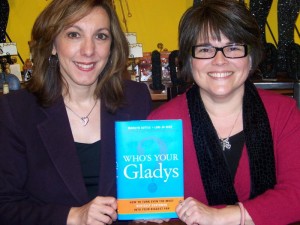
Guest post: Announcing the paperback release of Who's Your Gladys!


Note from Rich: Today’s guest post is an excerpt from the #1 customer service bestseller by my good friends and colleagues Marilyn Suttle and Lori Jo Vest, “Who’s Your Gladys? How to Turn Even the Most Difficult Customer into Your Biggest Fan” To celebrate the release of the paperback version, the authors are giving away free gifts with purchase here: www.whosyourgladys.com/paperbacklaunch

This excerpt from chapter 1 is based on interviews with Professional Movers, a world-class moving company located in Walled Lake, Michigan.

Eighty-seven-year-old Gladys has a reputation among her fellow retirement community members. She’s known as a cranky complainer who is impossible to please. But to her surprise, when she called Andrew Androff’s company, Professional Movers, to move her into her new apartment, she was treated with warmth and respect. When her sales rep, Chris, visited her home to quote the job, he noticed her prickly personality and made a conscious decision to focus on her spunk and tenacity. By the end of his visit, Gladys had bonded with Chris and booked the move.

On moving day, there was a mishap. One of the movers accidentally cracked Gladys’s marble tabletop. Andrew knew that she would be furious. Determined to set things right, he prepared himself to let her vent before she could even think about possible solutions. As predicted, Gladys had steam shooting out her ears.

Andrew felt compassion for her while she vented and assured her that his company would have the table repaired, and that if she wasn’t satisfied with the results, he would replace it. Although he continued to reassure her that things would be set right, she was still spitting mad. Gladys wanted to talk to Chris, who had sold her on the company in the first place, and Andrew promised to have Chris call her as soon as he came into the office.

Chris arrived dead tired after a long day filled with meetings with potential new customers. When Andrew told him about Gladys and asked if he’d be willing to call her, Chris responded, ‘‘No way. She’s going to need more than a phone call. I’ll stop by her house on my way home.’’ Chris arrived at Gladys’s house ready to comfort her through her anger and outrage. Then he assured her that he would personally oversee the repair of her table. This calmed her down, and she thanked him for coming over.

Unfortunately, the repair was less than perfect. Andrew knew that he had to set things right, even though doing so would be expensive. He called Gladys and promised that she could meet Chris at the marble store and personally pick out her new marble tabletop. Since Chris knew that Gladys didn’t drive, he called and arranged to pick her up and take her to the store himself.

Gladys is now living at one of metropolitan Detroit’s premier retirement communities with her new marble table. While it cost Andrew and his employee Chris extra time and extra money to make things right, the payoff was outstanding. Gladys tells everyone moving into or out of her assisted living complex that they have to hire Professional Movers if they want to work with the best movers in town. High and persistent praise from such a hard-to-please person attracts attention. As a result, Andrew’s company is now the number one choice of movers for Gladys’s retirement complex. By creating a culture that values compassionate connection with his customers, Andrew has built a referral base that has helped his sales grow by over 40 percent in two years.

This culture of connection has been particularly effective in building a strong business with senior citizens. Seniors often move from their homes to be nearer to their children or to retire to a senior community. Professional Movers has found this population to be a good fit for its particular style of customer service, so it put a great deal of effort into developing the market segment. Everyone at Professional Movers makes a practice of creating a human connection with her clients. The staff members show respect for their clients’ wisdom, experience, and opinions.  They also know how moving affects their clients, both physically and emotionally. It isn’t easy leaving behind the security of their homes, their friendships with neighbors, and the familiarity of their routines. Andrew’s employees are trained to be sensitive to the unique issues of downsizing. They are sensitive to the emotional connection to their precious family heirlooms that senior citizens feel as they leave behind the past. Professional Movers strives to give seniors the sort of service they would receive if their own family were doing the job.

‘‘It’s like we’re their sons,’’ Andrew said with a laugh. ‘‘We get very close with their families. We interview their caregivers and their social workers. It really helps us develop a customized process to address their concerns.’’ This needs-based approach to both customer service and sales has helped the company become the top provider of moving services in metropolitan Detroit’s retirement market.


Enjoy  “Who’s Your Gladys? How to Turn Even the Most Difficult Customer into Your Biggest Fan” - available at most online booksellers, or purchase it from Amazon.com here.

Monday, April 29, 2013

Rich Gallagher, LMFT


Some people's midlife crises involve sports cars or beautiful women. Mine involved deciding, in my 50s, to become a practicing psychotherapist.

Today I am proud to announce getting my New York State clinical license in marriage and family therapy.  As long as I behave myself and pay my renewal fees, I am now officially a therapist for the rest of my life. (Until now, I have been practicing under a supervised "learner's permit" that expires for good this year.) This marks the end of a long journey, and I couldn't be happier.

For me, this was always the path not taken, and one that called to me even as I pursued a seemingly more practical career (and my family's tradition) in technology. I even had a dual major in psychology as a Cornell engineering student in the 1970s, and was genuinely torn whether to become an engineer or a therapist. It was a heady time when people started to explore human potential and inner space, when I thought psychotherapists were the coolest people in the world. And I still do.

When I first started down this road in 2005, volunteering as a crisisline counselor, this was my dirty little secret - a Walter Mitty life I didn't tell most people about. When I started graduate school in 2007, videotaping my first counseling assignment, I felt like a rookie football player walking into an NFL locker room for the first time. And by the time I started my clinical practicum in 2009 - by which time I was seeing clients two days a week, as I do now - my secret was finally out.

So how do I feel after finishing graduate school and close to four years of supervised practice? First of all, I enjoy doing this as much as I thought I would. Ever since I was a young child wanting to become a Catholic priest when I grew up, my real goal in life was to help people be happier - not just write software and feed the cats and pay the mortgage. So for me this is an affirmation of life, as I transition to retirement in a few short years.

People often tell me, "I couldn't do counseling. Who wants to listen to other people's problems all day?" While it does have its moments, my experience is generally the opposite. Good therapy is a process of happymaking, and most people leave feeling better than when they came in. At least with me, a surprising amount of laughter takes place in session, even in some very serious situations. Even though this is very secular work, it often feels like we are creating a sacred space for people to be heard and understood, learn new skills, and make positive and fundamental life changes.

This work helps me too. It has introduced me to a larger community of therapists that has been incredibly generous of spirit with me, including three clinical supervisors (for my practicum in NY, my internship in PA, and my postgraduate clinical work) who have been the best and kindest mentors I could ever ask for. It dovetails nicely with my "day job" writing and speaking about communications skills. It opens up a whole new world of fascinating conferences and workshops. And yes, the things I have learned working with others benefit my own mental health and wellness.

From here, I hope to keep learning and growing. I already have a bucket list of things to explore further, ranging from my current specialty of treating anxiety disorders (my colleagues joke that I've become the "anxiety guy" at my current clinic) to going on retreat and exploring the nexus between psychotherapy and spirituality (another interest from my wannabe-priest days). Above all, I hope to keep doing well by my current and future clients, because that is what this is really all about. My sincere thanks to everyone who has supported me on this journey.

Friday, March 29, 2013

We're number 1 (again)!

When you release a new book on how to handle your very worst customer situations - and it becomes the #1 customer service book in America on the very first day it launches - that tells you this is a hot-button topic for people all over the country. (Even when it has a great launch campaign.) I couldn't be happier and more proud to be part of the dialogue on it.

Wednesday we kicked off the launch campaign for my new book The Customer Service Survival Kit with a webinar sponsored by Citrix GoToAssist and industry portal site (and longtime partner-in-crime) SupportIndustry.com. The energy level was incredible: we had over 1700 people signed up, almost 800 attending live, and enough questions to keep us running well past the top of the hour. And a truly amazing number of them went out and purchased the book afterward.

All of this tells me that people have a real hunger to learn how to handle their most difficult customers - especially today. Life is more stressful and fast-paced than ever, customers are more demanding, and sadly many people live in fear of being on the receiving end of a meltdown. But the good news is that by learning the same kinds of skills used by hostage negotiators, crisis counselors, and others, people can learn to completely blow away this fear and walk confidently into any customer situation. I wrote this book to take what I've learned as a former customer support executive - and practicing psychotherapist - and create an actionable game plan for mastering your very worst situations.

Some of you may know that this is actually my second #1 customer service book on Amazon.com, the first being my 2008 book What to Say to a Porcupine. (And I will never forget that taste of electricity in my mouth when it first hit #1.) But this new book had a very different vibe. First, Porcupine hit number 1 several months after its release, and its webinars drew barely half the audience of this new one. Second, it benefited from a good run in the bookstores and excellent press coverage, including being a finalist for 800-CEO-READ's business book of the year. By comparison, The Customer Service Survival Kit shot to the top right out of the starting gate, on the strength of a very timely topic.

This book also succeeded on the wings of a truly generous community of fellow authors, speakers, and thought leaders who helped me out in ways too numerous to mention. New York Times bestselling author and CNBC host Carol Roth, for whom I am a contributing blogger, not only wrote a great foreword but even offered up her cousin, an airline manager whose touching story of grief counseling after the 9/11 tragedy helped lead off the book. (Check out a great interview we just did on her midday show on Chicago superstation WGN, right here.) Countless others posted, tweeted, wrote reviews, offered launch gifts or cheered me on in ways I will always appreciate and cherish.

Above all, I want to thank you! The rave reviews and support I have received this week from the public has been overwhelming. If you haven't checked the book and its free gifts out yet, visit us here. Together, we are making the world a little nicer and a little safer from our very worst customer situations.

Saturday, February 23, 2013

Too Big to Listen: A "Brief" Course in Corporate Communications


One thing never ceases to amaze me: big companies whose responses to customers sound like they were written by robots.

Here is a recent example. At the risk of TMI, I recently wrote to one of my favorite big-box department stores about their men's underwear - or lack thereof. Here is what I wrote:

"I'll be brief - no pun intended.
Check out the men's underwear department at (my local store) sometime. You will find rows and rows and rows and rows of boxer briefs. And maybe two forlorn packages of briefs, of any brand - none in my size and colors, of course.
According to AskMen.com, 57% of men wear briefs, and 18% wear boxer briefs. Someone oughta clue in your underwear buyer. Thanks!
Best, Rich"

My note was short, to the point, well researched, and even a little humorous. It was not the least bit impolite. I even avoided the technically accurate groaner of signing off with my work address of Brief Therapy Associates (where I do actually practice as a therapist).

So here is the gist of their response -- with my thoughts in bold:

"Dear Richard,
Thank you for your comments regarding the current selection at your local store. At (insert name of big box store), our goal is to offer our customers a wide assortment of merchandise. In most cases, we offer a broad selection in our merchandise.
(Why, oh why, do most of these letters start by saying "Our goal is to do exactly the opposite of what we actually do"?)

We are continually looking for ways to best meet the needs of all customers and in turn, improve customer convenience.
(I am writing about something you do poorly -- and often -- and you respond by telling me how you are always busy improving? Methinks you've been looking under the wrong rock.)

Therefore, your feedback is very important and will be taken under consideration for any of our future buying decisions. We apologize for any inconvenience our current selection may have caused. We appreciate the time you took to contact us and look forward to serving you again at (insert name of big box store again).
(So my request has been put on the suggestion pile. Whoop-de-doo. I am thrilled, I tell you, thrilled.)
Sincerely, (whomever)"

So how should people react to this? Well, picture this. A mother catches her son with his hand in the cookie jar. He responds, "My goal is to only eat cookies at the appropriate times. I am always looking for ways to improve our supply of cookies as well as my dental health. Therefore your feedback is very important, and I will take it under consideration." Think this would work?

This is why the average six year old is smarter -- in fact, much smarter -- than the average big-box retailer. Meanwhile some corporate weenie is actually drawing a paycheck for penning words like these, for their customer service departments to cut-and-paste, thinking they will actually help.

Here is the response I was really thinking about: "Hey Rich. Sorry about that. We really should do a better job of stocking men's underwear. It's a hassle going all the way to a store and not finding something that basic in stock. We'll let you know when we fix this. Meanwhile, here's a five buck discount for your trouble. Thanks!" Now, would that be so hard?

Friday, January 25, 2013

The power of positive grumbling


I've been grumbling all day today. And for good reason:

·         First, I'm grumbling because I am busy. Really busy. Late-nighters and all-nighters all week busy. And I'm going to be busy for a while yet.
·         Second, I'm grumbling because I am in the middle of a 10-day-long course of antibiotics. One of its listed side effects is irritability. No fun.
·         Third, I'm grumbling because it's cold outside, and the walls seem to be shrinking in by about a foot a day.

So what's wrong with this picture? Here's what's wrong:

First, there are people out there who would give their right arm for the great workload I usually take for granted. To have a regular income coming in. To have the world validate their talents. To be self-employed and happy. I should be jumping for joy to watch the clock turn 2 AM. After all, I'm home, I'm safe, and I love what I am doing.

For some people, their days stretch sadly and endlessly ahead of them. But for me, I look ahead and see guest lectures to give, therapy sessions to hold, lunches with cool people, client projects to finish, even a new book to launch soon. Busy is way cool.

Second, what about the antibiotics? They are the greatest news in the world. At the risk of TMI, I had a health scare this fall when my PSA started climbing after a routine physical. Last week I just learned that I don't have prostate cancer - I have prostatitis. Prostatitis is awesome. It's fantastic. It's fixable. My doctor doesn't even want to see me for another six months. (And my PSA is returning to normal levels.) So I should be wolfing down these antibiotics with glee, irritability and all.

Third, about the cold: I am in a warm house with a beautiful woman, good food, great music, and a picture window that looks out over acres of rolling hills. I live in a great town. I am happy, healthy (prostatitis notwithstanding), and in love. And March is only five weeks away.

What I have just used here is a powerful technique from psychotherapy known as reframing. It is not the same as positive thinking. Rather, it takes reality - keeps it completely real - but frames it in terms that are much less scary. You can use it to describe life events, other people, or the way you are thinking. You could think of it as positive grumbling.

Reframing is very powerful. I've watched it change relationships and lift depressions. Today, it even made me stop grumbling. Try it yourself, and see what it can do for you!


Saturday, December 15, 2012

Dr. Richard H. Gallagher: A tribute


(Note: My late father would have been 85 years old this year. Sadly his life was cut short just before his 70th birthday, on September 30, 1997, after bravely battling a rare form of cancer while at the peak of his career as President of Clarkson University. He was one of the pioneers of modern engineering design analysis.

This tribute was originally written by me just before his passing, and sent to his professional colleagues after he died. I recently discovered that its original web host is now defunct, and wanted to preserve this online for posterity on my own blog.)

My father was, on the surface, one of the most improbable people one could imagine as a pioneer of modern engineering analysis. He was a kid from the Bronx who left home at age 16 to try and join the military, and describes his entry into engineering school as being almost an afterthought following the end of World War II and his Navy enlistment. He later graduated from an engineering program in New York that no longer exists, and was nearly in his forties, supporting a wife and five children, when he earned his doctorate in night school at an institution that had never granted them in his field before.

His accomplishments since then could easily fill the successful careers of several people, and many people who know him from one field are unaware of his accomplishments in others. He progressed from being a practicing engineer, to an industry pioneer of the finite element analysis method, to a distinguished Ivy League teaching career, to becoming a highly successful academic official and university president. In each of these diverse activities, he not only succeeded, but received the highest honors of each field in turn.

Behind the official accolades, however, was a very modest and private person whose personal integrity was absolute. During his retirement from the presidency of Clarkson University, the one comment we heard the most from his colleagues was "Dick is the most solid person I've ever known", and this was as true in his personal life as it was in his career. He never boasted of his achievements off-camera - his work itself gave him pleasure, and it sustained him day and night throughout his entire working life.

He felt that technology was an important means of improving everyone's success in life, and was a tireless proponent of both bringing more women and minorities into the engineering field, as well as helping practicing engineers to become lifelong learners. And even as a young engineer, he saw his field in very global terms. I will never forget, as a young boy, seeing how excited he was about presenting one of his first papers in Stuttgart, Germany -- he put aside finite elements for weeks in a crash effort to learn German, and gave a successful lecture.

From there, our family quickly became used to seeing him travel to Asian universities, behind Iron Curtains, and to every continent on earth as an active member of the FEA fraternity, while he and his wife Terry increasingly became host to a steady stream of international visitors. Early in his life, he developed a habit of purchasing a ceramic mug from each institution he would lecture at, and this massive international collection of beer steins remains a testament to his globetrotting support of the field.

It is a well-known "secret" among Dick's colleagues that all five of his children became engineering graduates, and pursued successful technology careers of their own. What is less known is that this was never his wish. I don't believe that he ever expressed a career preference to any of his children as they grew up, and was in fact a strong proponent of the classic liberal arts education; indeed, he married a cum laude graduate in English who was a published poet and a promising advertising copywriter. At home, he would light up as much talking about world history and popular culture as he ever did about engineering analysis, and we all remember road trips which would stop at every historical site, castle or bridge within range of our route. The fact that each of his offspring chose to pursue technology instead is a testament to how brightly his enthusiasm glowed for his own work, and his wish for at least one of us to become a person of arts and letters stands as one of few goals that he ever failed at.

Sharing the same name as my father, I experience constant reminders of his impact on the engineering field. At times, people mistaking me for him laud the impact of "my" books and papers on their careers; more often, they go out of their way to share what an influence the man and his work has been to them. His efforts literally paved the way for a multi-billion dollar industry, thousands of careers, and millions of lives improved.

In his last commencement speech at Clarkson, which he gave shortly after learning of his illness, he spoke in a strong, clear voice of how we must all have a sense of urgency in our lives, how quickly his own 45 year career had passed, and how the decisions we make early on affect us for the rest of our lives. The decisions that he made in his own life benefited all of us.

Wednesday, December 05, 2012

Me ... live ... inexpensively ... at your company!


(This is a shameless plug from my friends at SupportIndustry.com. Did you know that I do inexpensive custom webinars for customer contact operations worldwide through SupportIndustry.com, on areas like customer skills, supervision, and workplace communications? My webinar client list includes firms like Mattel, Employers Mutual Casualty (where we trained 200 managers live across the country, with remote facilitators and team exercises), and many others. Check this out and give Carolyn a call!)

You want to motivate and train your support staff, but with limited resources, it is hard to get them off the phones for a full day of training. SupportIndustry.com has an alternative.
SupportIndustry.com has conducted hundreds of webinars and can provide you with a custom webinar that provides your agents with the specific tools they need to deal with issues such as:
  • Understanding and dealing with your most difficult customers
  • Communication skills for every customer situation
  • Working effectively with the entire team
  • Productivity skills for customer transactions
We can also help your managers deal with their greatest challenges, including:
  • Understanding and managing different team personalities
  • Learning what motivates your staff
  • Understand how your leadership style affects your workplace
  • Make real, tangible changes in your workplace performance, morale and success
So, how does it work? We will talk with you to determine the biggest issues currently facing your organization, and put together a webinar designed to meet your needs. Your support staff will attend a customized workshop designed to address their most pressing issues.
Remember - research shows that employees are most happy when the companies they work for invest in training to enable them to do their job better. So help your support staff start 2013 out right and show them you are committed to helping them succeed!

For more information, e-mail me at chealey@supportindustry.com or give me a call at 805.569.5761.
Thank you!
Carolyn Healey
Publisher
http://www.SupportIndustry.com
http://www.CRMindustry.com
http://www.RecognizeServiceExcellence.com

Saturday, December 01, 2012

The view from this far


This week I enter my 59th year. So what does it feel like to be approaching my 60s? The real answer is a little complex, but I'll give it a try.

The first answer is that I feel this is an ideal age. I wish I could stay here for a while. I wake up feeling pretty good every morning, with someone I am still madly in love with, but with the advantage of a lot more experience, wisdom, and resources versus when I was younger.

In some ways this age is liberating. Take career issues, for example. I remember all too well how painful it was to be struggling with making a living in my 30s and 40s. When you are that age, career problems loom extremely large, because you have to worry about supporting yourself for another quarter-century or more. Nowadays I can see the light at the end of the tunnel.

Aging also liberates you from people's expectations. In my 20s and 30s, with an engineering degree and a hot technical career, any suggestion of trying another path was met with alarm by my friends, my relatives, and my mortgage. Now no one cares anymore, so I get to do whatever I want. And ironically I am busier and more successful than ever - although if you ask me what I do for a living, allow enough time for a lengthy answer.

At the same time, there is a twinge of sadness that time marches on. You notice it when you scan your iTunes playlist and see how many of the artists you grew up with have passed on. You look through your Facebook friends list and see that a lot of your colleagues are retired. Or you call your mother and she doesn't remember your wife's name anymore. I had a bit of a shock last month when we got tickets to see Chicago and the Doobie Brothers - groups that formed the soundtrack to our dating years - and realized that their original members are all roughly 70 years old now. So as much fun as it is to be here now, I still have to wrap my head around the fact that it doesn't end there.

Which leads to another conundrum. I am still very much in the arena these days. I write, I speak, I travel, and I have a new book coming out next year from a major publisher. Thankfully I am busy enough to be working far too many hours, and have been for a long time. Do I plan to shut all this down and start playing shuffleboard in a few years? No. So what does retirement look like for someone like me?

I frankly haven't figured that one out yet. To be as busy as I am now into, say, my 70s sounds kind of stupid, especially when I could be sharing a lot more sunsets with Colleen. But when you are a go-getter like I am, simply watching the sun set every night would be a recipe for boredom and depression. I never intend to retire in the traditional sense of the word, but the challenge will be striking a balance with the many things I truly enjoy.

Perhaps my latest venture is a good metaphor for where my life seems to be heading. Years ago I quietly went back to graduate school to pursue a longstanding pipe dream: becoming a psychotherapist as I transitioned into retirement. Nowadays I am in practice a couple of days a week, on top of all the other crazy things I do, and Colleen gets to chuckle at me when my schedule is full or I have to rush out for a crisis intervention. (One of my brothers put it even more succinctly, saying you couldn't force him to do this at gunpoint.) But I enjoy it, and did this intentionally to stay relevant as I age and the phone stops ringing in my consulting practice. Except that it hasn't stopped ringing yet. So that may be what my retirement looks like after all: reasonably well planned, focused on things I love, and perhaps busier than I expected. Stay tuned!